

Faster production and subtler defects are putting manual QC under strain. Small errors cause major waste and put a company's reputation at risk. How can you achieve 100% quality control? The answer is QC Gate, an automated visual inspection machine. It acts as a digital line of defense that stops product defects at the source.
WHAT IS QC GATE? DEFINITION AND CORE CONCEPT
QC Gate (Quality Control Gate) is a quality checkpoint placed at each critical process step of a production line.
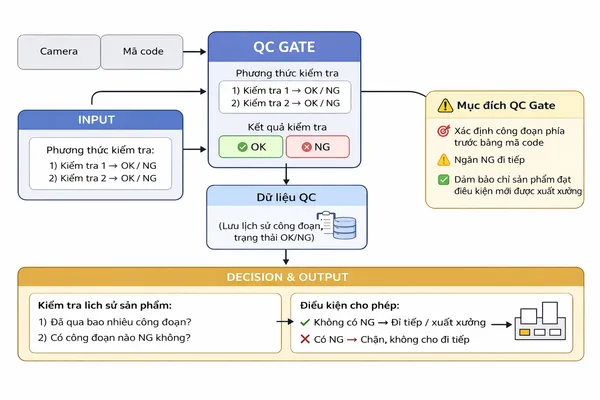
It works as an intelligent "gatekeeper". It reads a QR code to check the upstream process steps and evaluates product quality on the spot before the product can move to the next step.
CONTACT US FOR A CONSULTATION!
The QC Gate solution delivers practical value: higher product quality, defect containment, optimized production processes and less waste. QC Gate also cuts labor costs, standardizes inspection and prevents process steps from being missed or skipped. It is an important tool for keeping product quality consistent and improving it in modern, automated manufacturing.
CORE OBJECTIVES OF ESTABLISHING QR CODES
Implementing QC Gate is more than an inspection procedure. It also serves strategic objectives:
- Traceability: Use QR codes or other identification methods to quickly see which upstream process steps a product has passed through.
- Instant sorting: Sort products into two clear groups: OK (Pass) and NG (No Good).
- Defect containment: This is the most important role. NG products are fully blocked from moving further down the line, which reduces rework and scrap costs at the end of the line.
- Automation & Recording: Inspection and quality status recording are automated, which reduces reliance on manual work and eliminates human error.
CURRENT SITUATION AND THE NEED FOR QC GATE AUTOMATION
Many factories are investing heavily in modern machinery to automate production and replace large numbers of manual workers.
The concern is that while production machinery has advanced, many companies still lack an automated quality control system that covers the whole line. Without automated quality control (QC) during production, the overall efficiency of an automated line suffers. QC Gate is the solution that fills this gap.
QC GATE MACHINE STRUCTURE AND FEATURES
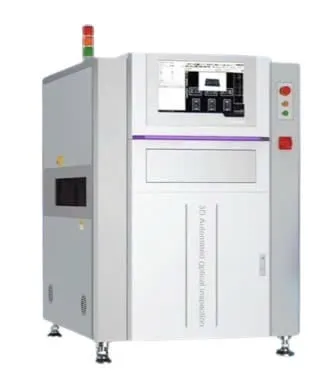
| MACHINE STRUCTURE | MACHINE FEATURES |
|---|---|
| Mechanical and control equipment: Includes machine frame, PLC, communication modules, high-speed counters, encoders… | Template comparison: The automated optical inspection (AOI) system compares captured images with preset reference images. |
| Optical support system (lighting and camera lenses): Includes lighting units and camera lenses… | Object detection: The automated optical inspection system can be placed in the production line directly after the soldering process, so problems are detected early in production. |
| Image processing and analysis camera: Captures images, processes them and identifies defective products | Product sorting: The machine detects incorrect components, missing components or misplaced parts and classifies product defects. |
| Monitoring and reporting software: Processes images, analyzes data, outputs inspection results and produces product quality statistics | Surface inspection: The visual inspection machine detects many typical surface defects such as bumps, scratches and stains. It also detects familiar dimensional defects such as open circuits, short circuits and insufficient solder. |
ROLES AND FUNCTIONS OF QC GATE
QC Gate ensures product integrity from start to finish:
- Defect traceability: Quickly check how many process steps a product has passed through and whether any step was NG. It also checks whether workers skipped any step.
- Movement control: Only qualified products, with no NG status from any earlier step, can move on to the next step or be shipped.
Advanced Function: QC Gate Data Analysis
An intelligent QC Gate system provides powerful statistics and analysis functions:
- Statistics: Counts OK/NG products by process step and product type, so defect "hot spots" are identified immediately.
- Status reporting: Tracks the quality status of each product type and gives an overview of quality performance.
ANALYSIS, IMPROVEMENT AND PROCESS OPTIMIZATION
This final step matters most for building a competitive advantage. The collected QC data is used for:
- Root-cause analysis: QC data serves as the basis for analyzing the root causes of defects.
- Defect mapping: A process flow map is built with the Yield Rate at each Gate to show where defects concentrate.
- Improvement actions: Based on these findings, permanent corrective measures are put in place and production processes are improved.
CONCLUSION: BUILDING A DATA-DRIVEN PRODUCTION MODEL
QC Gate is more than an inspection tool. It is a quality management system built on real production data. Its ultimate goals are to:
- Make the entire production and quality process transparent.
- Create a specific resolution model for each issue.
- Optimize production through decisions based on transparent quality data.
Adopting QC Gate is a strategic step. It helps companies become more competitive, secure output quality and move toward a smart, lean factory.
CONTACT US FOR A CONSULTATION!
CONTACT INFORMATION
SAOMAI SOLUTION GROUP JSC
Address: 25 Nguyen Quoc Tri, Cau Giay, Hanoi
Hotline: 0908184188/ 0869191169
Email: info@saomaisoft.com
Website: https://ssg-vietnam.com/
Fanpage: https://www.facebook.com/saomaisoft